Where Can I Meet Older Women to Have Sex Wth

Dating has always come up with challenges. But the advent of dating apps and other new technologies – equally well as the #MeToo movement – presents a new set of norms and expectations for American singles looking for casual or committed relationships, according to a recent Pew Research Center survey.
Some 15% of U.S. adults say they are single and looking for a committed relationship or casual dates. Among them, virtually say they are dissatisfied with their dating lives, according to the survey, which was conducted in October 2022 – before the coronavirus pandemic shook up the dating scene. Hither are some additional key findings from the study.
Pew Research Center conducted this report to understand Americans' attitudes toward and personal experiences with dating and relationships. These findings are based on a survey conducted Oct. 16-28, 2019, among 4,860 U.S. adults. This includes those who took part as members of the Center's American Trends Panel (ATP), an online survey panel that is recruited through national, random sampling of residential addresses, as well as respondents from the Ipsos KnowledgePanel who indicated that they identify as lesbian, gay or bisexual (LGB).
Recruiting ATP panelists by telephone or postal service ensures that virtually all U.Due south. adults accept a gamble of selection. This gives us confidence that any sample can stand for the whole U.S. adult population (meet our Methods 101 explainer on random sampling). To further ensure that each ATP survey reflects a counterbalanced cross-section of the nation, the data is weighted to match the U.S. adult population by gender, race, ethnicity, partisan affiliation, instruction and other categories.
For more, see the report's methodology about the project. You tin can also find the questions asked and the answers the public provided in this topline.
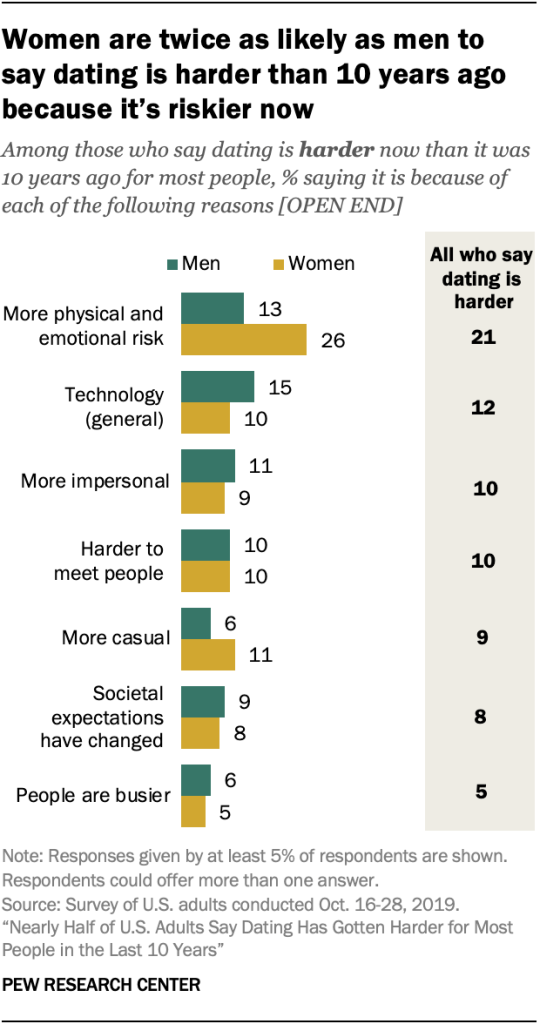
About half (47%) of all Americans say dating is harder today than it was 10 years ago. A third of adults (33%) say dating is virtually the aforementioned every bit information technology was a decade agone, and 19% say it'due south easier. Women are much more than likely than men to say dating has gotten harder (55% vs. 39%).
Among those who say dating is harder today, 21% recollect it is because of increased risk, including physical risks likewise every bit the risk of getting scammed or lied to. Women are twice as probable as men to cite increased run a risk as a reason why dating is harder (26% vs. 13%).
Other reasons why people remember dating is harder include technology (12%), the idea that dating has get more impersonal (10%), the more casual nature of dating today (9%), and changing societal expectations, moral or gender roles (8%).
Technology tops the listing of reasons why people recollect dating has gotten easier in the final decade. Amid those who say dating is easier today, 41% point to technology, followed by 29% who say information technology's easier to meet people now and x% who cite changing gender roles and societal expectations.
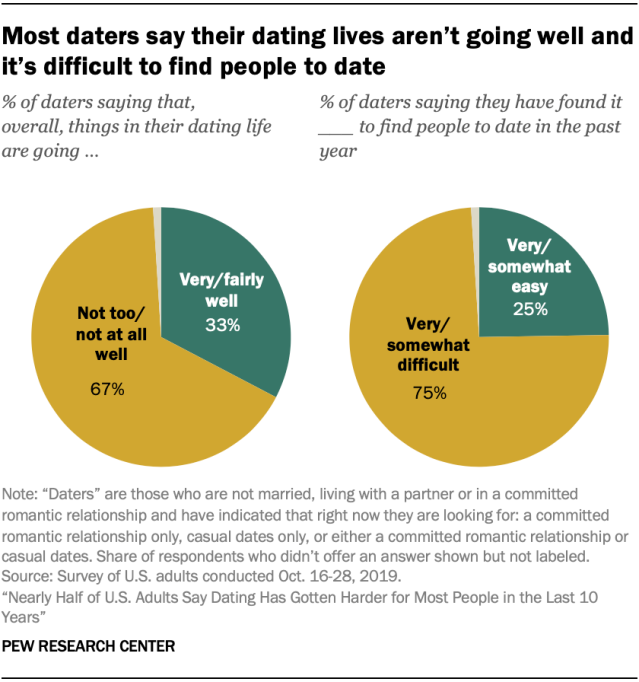
Most daters don't feel similar their dating life is going well and say information technology'south been hard to observe people to engagement. 2-thirds of those who are single and looking for a human relationship or dates say their dating life is going not too or not at all well (67%), while 33% say information technology's going very or adequately well. Majorities of daters across gender, historic period, race and ethnicity, education, sexual orientation and marital history say their dating life isn't going well.
Iii-quarters of daters say information technology's been hard to find people to engagement in the past year, according to the pre-coronavirus survey. Among the peak reasons cited are finding someone looking for the aforementioned type of relationship (53%), finding information technology hard to approach people (46%) and finding someone who meets their expectations (43%).
Substantial shares of daters as well report other obstacles, including the limited number of people in their surface area (37%), being besides busy (34%) and people not existence interested in dating them (30%).
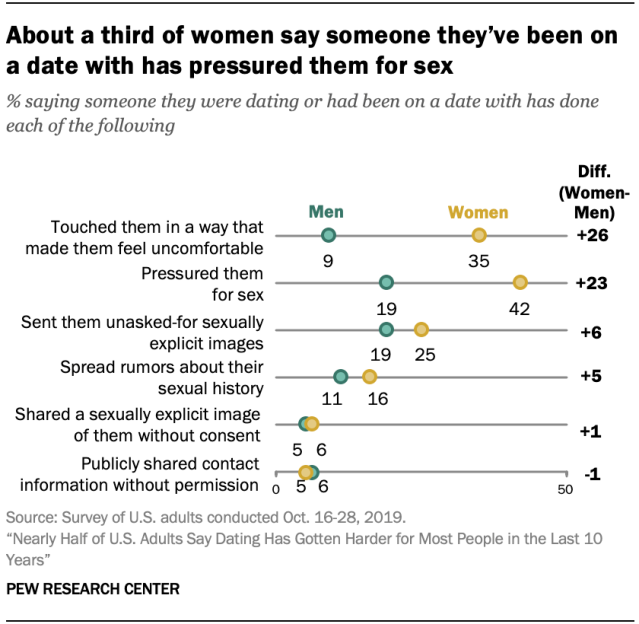
A majority (57%) of women – and 35% of men – say they take experienced some kind of harassing behavior from someone they were dating or had been on a appointment with. Women are much more likely than men to say they take been pressured for sexual activity (42% vs. 19%) or take been touched in a way that fabricated them feel uncomfortable (35% vs. ix%). While the gender gap is smaller, women are also more probable than men to say someone they have been on a date with sent them unwanted sexually explicit images or spread rumors about their sexual history.
Some 42% of women younger than xl say someone they've been on a date with has sent them unwanted sexually explicit images, compared with 26% of men in this age group. And while 23% of women younger than 40 say someone they have been on a date with has spread rumors well-nigh their sexual history, sixteen% of younger men say the same. There is no gender gap on these questions among those older than forty.
Many Americans say an increased focus on sexual harassment and assault has muddy the waters, especially for men, in the dating landscape. A majority of Americans (65%) say the increased focus on sexual harassment and assail over the last few years has made it harder for men to know how to interact with someone they're on a date with. About one-in-iv adults (24%) say information technology hasn't made much of a divergence, while 9% say it has made things easier for men.
Meanwhile, 43% of Americans say the attending paid to sexual harassment and assault has fabricated it harder for women to know how to interact with someone they're on a appointment with, compared with 38% who say it hasn't fabricated much of a difference and 17% who say it'southward easier for women.
Men are more likely than women to call back the focus on sexual harassment and attack has made information technology harder for men to know how to act on dates. Republicans and Republican-leaning independents are more probable than Democrats and Autonomous leaners to say this. Older men are likewise more likely than their younger counterparts to hold this view: Iii-quarters of men 50 and older say it's harder for single-and-looking men to know how to behave, compared with 63% of men younger than 50.
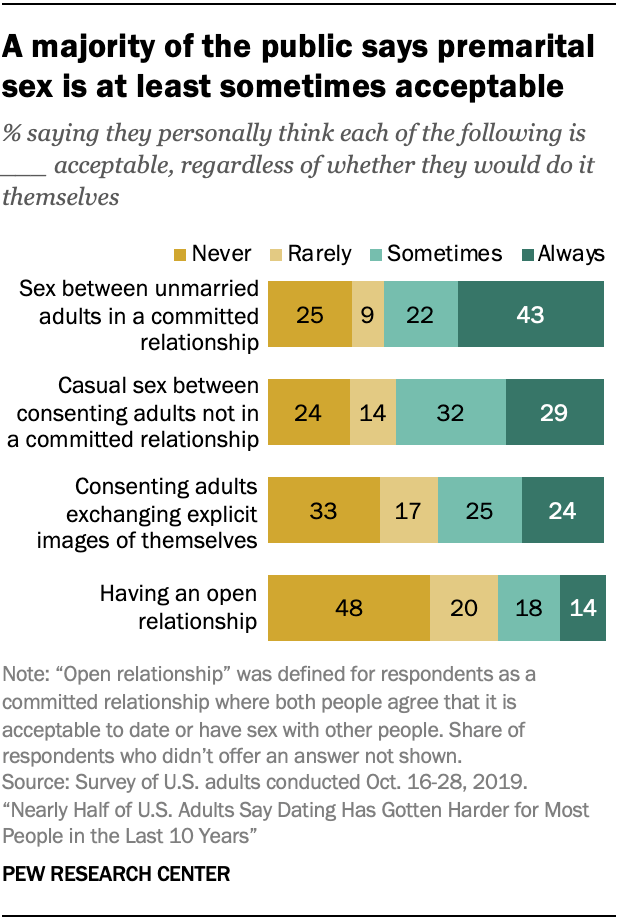
Premarital sex is largely seen as acceptable, but more Americans meet open relationships and sex on the beginning date as taboo. Most adults (65%) say sexual activity between unmarried adults in a committed relationship tin exist adequate, and about half-dozen-in-ten (62%) say casual sex between consenting adults who aren't in a committed relationship is adequate at to the lowest degree sometimes. While men and women have similar views about premarital sexual practice, men are much more than likely than women to find coincidental sex adequate (70% vs. 55%).
Americans are less accepting of other practices. For case, open relationships – that is, committed relationships where both people agree that it is acceptable to date or take sex with other people – are viewed as never or rarely acceptable by most Americans. Well-nigh half of adults (48%) say having an open up relationship is never acceptable, 20% say it'southward rarely acceptable and 32% say it's sometimes or always acceptable.
When information technology comes to consenting adults sharing sexually explicit images of themselves, well-nigh one-half of adults (49%) say it is at least sometimes adequate, while a similar share (l%) say it is rarely or never acceptable. However, there are big age differences in views of this do. Adults ages 18 to 29 are more than than three times as probable as those 65 and older to say this is ever or sometimes acceptable (70% vs. 21%). Younger adults are also more likely to say open relationships can exist acceptable.
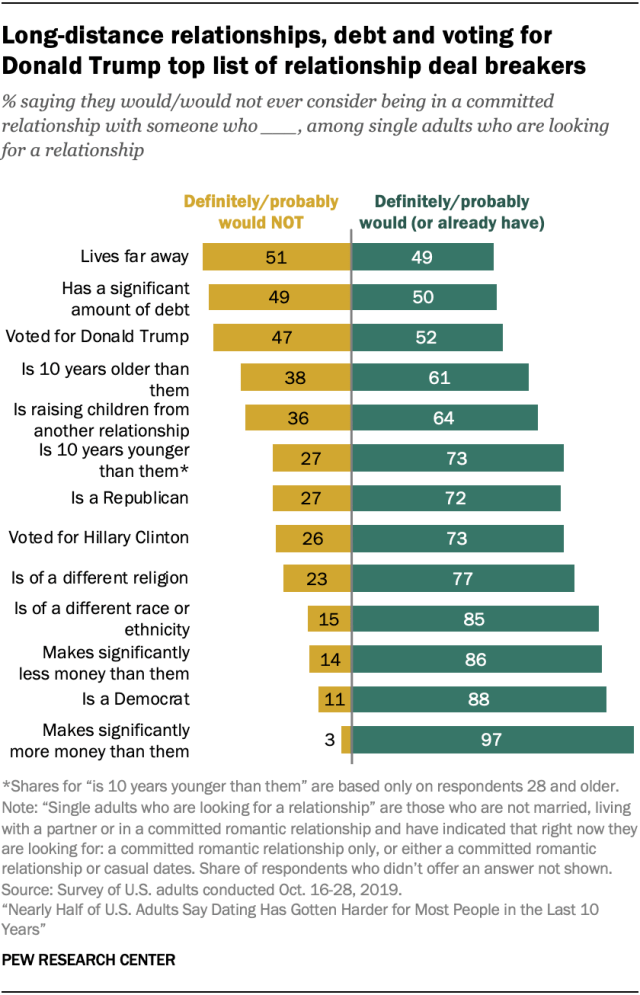
Many singles are open to dating someone who is different from them, just certain characteristics would requite some people pause. Distance, debt and voting for Donald Trump meridian the list of reasons singles looking for a relationship wouldn't consider a potential partner, but in that location are other considerations, also. For instance, 38% say dating someone x years older than them would give them intermission, and 36% say the same almost dating someone who is raising children from another relationship. Some of those looking for a human relationship also say they definitely or probably wouldn't consider being in a relationship with someone who is a Republican (27% of all daters), someone who voted for Hillary Clinton (26%), someone who practices a different religion (23%) or someone who is a different race or ethnicity (15%). Amongst daters looking for a relationship who are 28 and older, 27% say they definitely or probably wouldn't consider a relationship with someone 10 years younger than them.
There are some differences in these attitudes by gender, political party and historic period. For example, unmarried women looking for a relationship are roughly three times every bit likely every bit men to say they wouldn't consider a human relationship with someone who makes significantly less money than them (24% vs. seven%). Republicans are more likely than Democrats to say they probably or definitely wouldn't consider a committed relationship with someone of a different race or ethnicity (21% vs. 12%). And when it comes to debt, 59% of adults 40 and older say they probably or definitely wouldn't consider a committed relationship with someone who has significant debt, compared with 41% of people younger than 40.
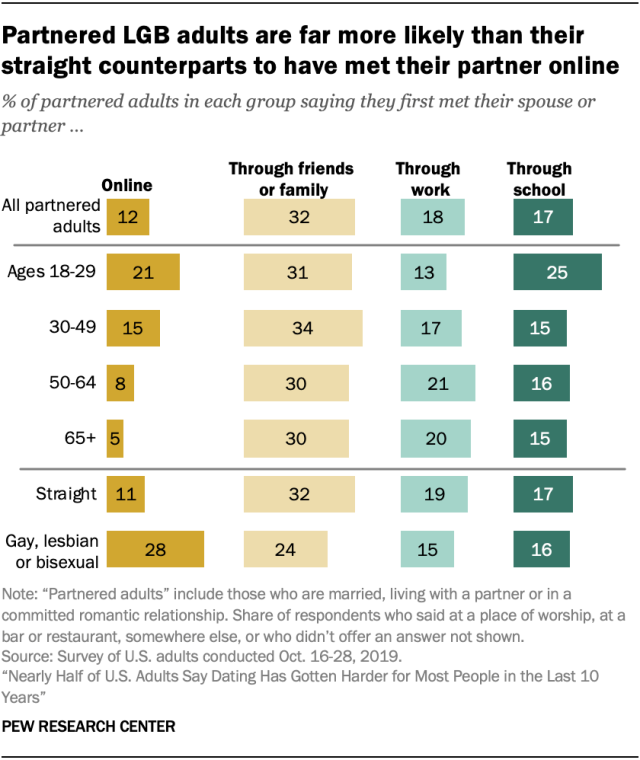
While meeting partners through personal networks is even so the most common kind of introduction, about one-in-ten partnered adults (12%) say they met their partner online. Most a third (32%) of adults who are married, living with a partner or are in a committed relationship say friends and family helped them find their match. Smaller shares say they met through work (18%), through school (17%), online (12%), at a bar or eating house (8%), at a place of worship (v%) or somewhere else (8%).
Meeting online is more common amongst younger adults and those who alive in urban and suburban areas, as well as those who are lesbian, gay or bisexual (LGB). About i-in-v partnered adults ages 18 to 29 (21%) say they met their partner online, compared with 15% or fewer among their older counterparts. And while 28% of partnered LGB adults say they met their partner online, 11% of those who are straight say the aforementioned.
Among those who met their partner online, 61% say they met through a dating app, while 21% met on a social media site or app, x% met on an online discussion forum, 3% met on a texting or messaging app and three% through online gaming.
Half of singles say they aren't currently looking for a human relationship or dates. Amongst these single non-daters, 47% say a major reason why they aren't currently looking for a relationship or dates is that they have more important priorities, while 44% say they merely similar being single. Other factors include being too busy (twenty%), not having had luck in the past (18%), feeling like no one would be interested in dating them (17%), not being ready to date after losing a spouse or ending a relationship (17%), feeling too onetime to date (17%) and having health problems that make dating difficult (11%).
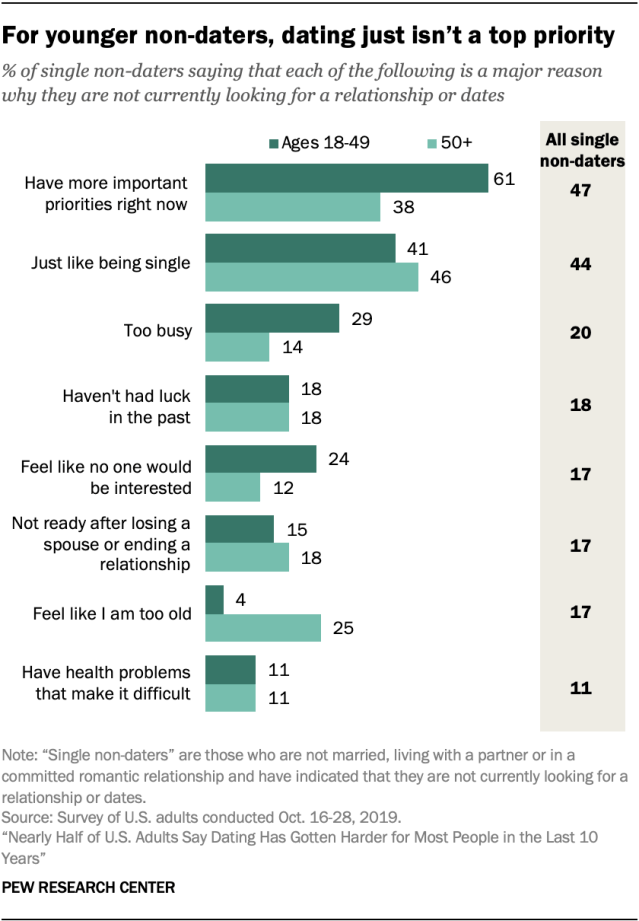
While these answers are mostly similar for men and women, there is 1 notable exception: Male person non-daters are nearly twice as likely as female non-daters to say a major reason they aren't looking to date is the feeling that no one would exist interested in dating them (26% vs. 12%).
At that place is likewise some variation by age. For case, 61% of non-daters younger than 50 say that a major reason they aren't looking to date is that they have more of import priorities, compared with 38% of older not-daters. And a quarter of not-daters ages 50 and older – including 30% of those 65 and up – say a major reason is they that experience too old to date.
Annotation: Here are the questions asked for this report, along with responses, and its methodology.

Amanda Barroso is a former writer/editor focusing on social trends at Pew Research Heart.
Source: https://www.pewresearch.org/fact-tank/2020/08/20/key-takeaways-on-americans-views-of-and-experiences-with-dating-and-relationships/
0 Response to "Where Can I Meet Older Women to Have Sex Wth"
Post a Comment